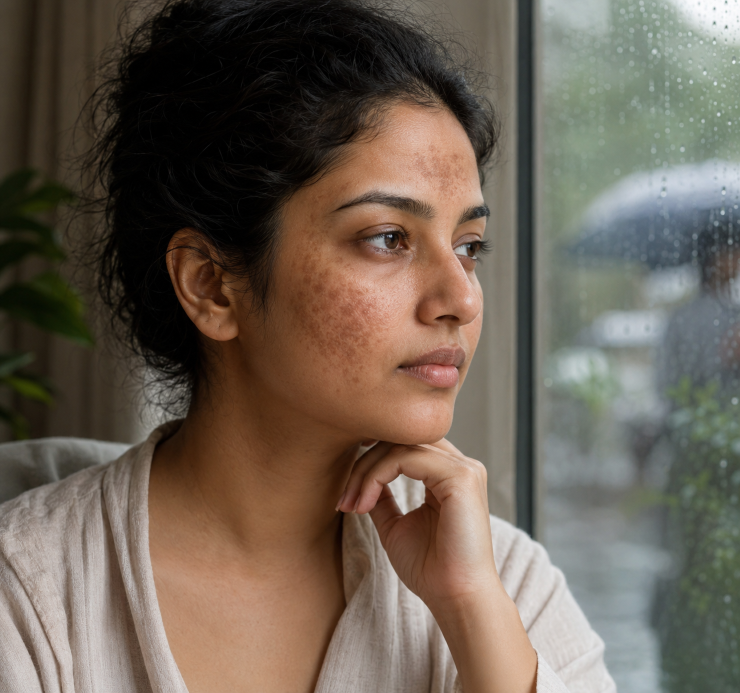
Most people assume that once the sun disappears behind monsoon clouds, their skin gets a break too. For those living with melasma, that assumption can be misleading — UV and visible light don't switch off just because it's raining, and monsoon habits like skipping sunscreen, sweating more, and wiping the face repeatedly can quietly undo months of careful skin management.
"My melasma looks darker this monsoon — why?" is one of the most common questions I get asked once the rains set in Kolkata. The truth is a little more nuanced than 'yes' or 'no.
Does Melasma Really Get Worse During Monsoon?
Melasma may appear darker or more noticeable during the rainy season, but humidity or rainfall by itself is not an established direct cause. What actually drives melasma are factors such as ultraviolet (UV) exposure, visible light, heat, hormonal changes, genetics, and skin irritation. Monsoon habits and routines often make an already existing case of melasma harder to manage, even if the season isn't the root cause.
Ultraviolet and visible light are known to stimulate pigment-producing cells. Both can aggravate melasma, especially in medium-to-deep skin tones — the skin type a dermatologist can see most commonly in Kolkata.
Cloudy Weather Does Not Mean Zero Sun Exposure
One of the most common misconceptions is that clouds block the sun completely. It doesn't. A significant amount of UV radiation still passes through clouds and reaches the skin. Because the sky looks dull, many people simply skip sunscreen altogether during the monsoon.
Even short outdoor moments — commuting, a quick errand, school pickup, or standing near a window — add up over the day. Managing melasma effectively requires consistent protection, not protection reserved only for bright, sunny days.
Can Visible Light Also Affect Melasma?
Melasma isn't influenced by UV rays alone — visible light also deepens pigmentation, an effect more pronounced in medium-to-deep skin tones. This is why dermatology guidelines increasingly recommend tinted sunscreens containing iron oxide for melasma-prone skin, offering protection against visible light in addition to standard UV coverage.
How Sweat and Rain Affect Sunscreen Protection?
Sweat does not directly cause melasma, but it can compromise the protection your sunscreen is meant to provide. Rain, frequent wiping of the face, and use of a handkerchief or towel can physically remove part of the applied sunscreen layer.
During humid weather, sunscreen may need to be reapplied more often, especially after heavy sweating. Choosing a water-resistant, lightweight, non-greasy formula can make consistent use easier — but remember, "water-resistant" does not mean permanently waterproof.
Can Heat Make Pigmentation Look Darker?
The evidence here is less clear-cut than for sunlight. Heat is being studied as a possible contributor to pigmentation, with factors like hot kitchens and prolonged outdoor commuting playing a role for some individuals. Even so, heat should not be treated as the primary cause of melasma flares — sunlight and visible light remain the better-established triggers.
Why Does Skin Irritation Matter During Monsoon?
Humid weather often pushes people toward habits that can quietly worsen pigmentation:
- Washing the face too frequently
- Using harsh, oil-stripping face washes
- Applying scrubs or peels more often than needed
- Experimenting with bleaching creams or home remedies
- Combining multiple active ingredients without guidance
Any product that causes burning, stinging, or visible irritation can make dark patches more prominent. Gentle, fragrance-free skincare remains the safer choice for melasma-prone skin — a principle emphasised across clinical dermatology in Kolkata and elsewhere.
Common Monsoon Mistakes That May Worsen Melasma
- Skipping sunscreen on cloudy or rainy days
- Applying too little sunscreen
- Not reapplying after heavy sweating
- Rubbing the face repeatedly with a towel
- Using strong scrubs to control oiliness
- Trying unprescribed lightening or steroid-containing creams
- Stopping prescribed treatment as soon as patches start fading
- Expecting a single product to remove melasma permanently
A Simple Monsoon Routine for Melasma-Prone Skin
Morning
- Use a gentle cleanser
- Apply a suitable moisturizer if needed
- Use a broad-spectrum sunscreen of at least SPF 30
- Consider a tinted sunscreen containing iron oxide
- Use a hat, umbrella, or shade during longer outdoor exposure
During the Day
- Reapply sunscreen after sweating or wiping the face
- Pat the skin gently instead of rubbing
- Limit unnecessary exposure to intense sunlight and heat
Evening
- Cleanse gently to remove sunscreen, sweat, and pollutants
- Use only products suited to your individual skin
- Avoid introducing several new active ingredients at once
Should Melasma Treatment Change During Monsoon?
Treatment should not be started or stopped simply because the season has changed. Some topical medications can irritate the skin if used incorrectly, and procedures such as chemical peels or lasers require proper diagnosis and aftercare — they are not suitable for every patient. Melasma generally needs long-term, consistent control rather than a one-time fix.
Melasma or Another Type of Pigmentation?
Not every dark patch on the face is melasma. Tanning, post-inflammatory pigmentation, and medication-related pigmentation can look quite similar. Melasma typically presents as symmetrical brown or grey-brown patches on sun-exposed areas such as the cheeks, forehead, upper lip, and nose — distinguishing between these often requires the trained eye of a skin specialist in Kolkata or elsewhere, rather than guesswork based on appearance alone.
When Should You Seek a Dermatological Evaluation?
A dermatological evaluation is worth seeking if:
- Pigmentation is appearing for the first time
- Patches are spreading quickly
- The skin feels itchy, painful, red, or is peeling
- Over-the-counter products are causing burning
- Pigmentation appeared during pregnancy or after starting hormonal medication
- You have used unlabelled or steroid-containing creams
- Patches are not responding to a consistent routine
- The diagnosis feels uncertain
In Closing
Monsoon does not give melasma a season off, especially in Kolkata. Consistent light protection, gentle skincare, and an accurate diagnosis remain important even when the weather looks grey and forgiving. If pigmentation is changing or not responding as expected, a timely evaluation by a good skin doctor is generally the safest next step.
Author:
Dr. Oindrila Dutta
Consultant Dermatologist and Dermatosurgeon
MBBS (Gold Medalist)
MD in Dermatology
International Fellowship in Aesthetic & Laser Dermatology (DIAS, ASI-Australia)
Frequently Asked Questions
1. Can melasma go away completely during monsoon if I avoid the sun?
No. Melasma is chronic and does not resolve simply because sun exposure is lower on cloudy days. Consistent protection can prevent it from worsening, but it does not cure the condition.
2. Is sunscreen necessary indoors during monsoon?
Yes, especially near windows or skylights, since visible light and daylight indoors can still affect melasma-prone skin.
3. Does sweating cause melasma to spread?
No. But it can wash away sunscreen, leaving skin under-protected, and frequent wiping can irritate skin and make pigmentation more noticeable.
4. Are home remedies like lemon, turmeric, or besan safe for melasma?
Not without medical guidance. Such remedies can irritate the skin barrier and worsen the appearance of melasma rather than improve it.
5. Should I wait until the monsoon ends to start melasma treatment?
No. Treatment can be started or continued in any season, provided sun protection and skincare routines are followed correctly. Delaying it often makes pigmentation harder to manage later.
[This article is for general educational purposes and does not replace an in-person consultation. Treatment plans should always be discussed with a qualified dermatologist based on a proper skin examination.]
Ready to Transform Your Skin Health?
Take the first step towards a radiant, healthy skin with expert care from Dr. Oindrilla Dutta. Book your consultation today and discover personalized solutions for all your dermatological needs!

Recent Post
-
 October 07, 2026
Skin Looking Dull & Dehydrated? Know What Skin Boosters Can Do
-
 September 28, 2026
Why Does My Ingrown Toenail Keep Coming Back After Surgery?
-
 September 21, 2026
Not Every Raised Scar Is a Keloid: Know the Difference