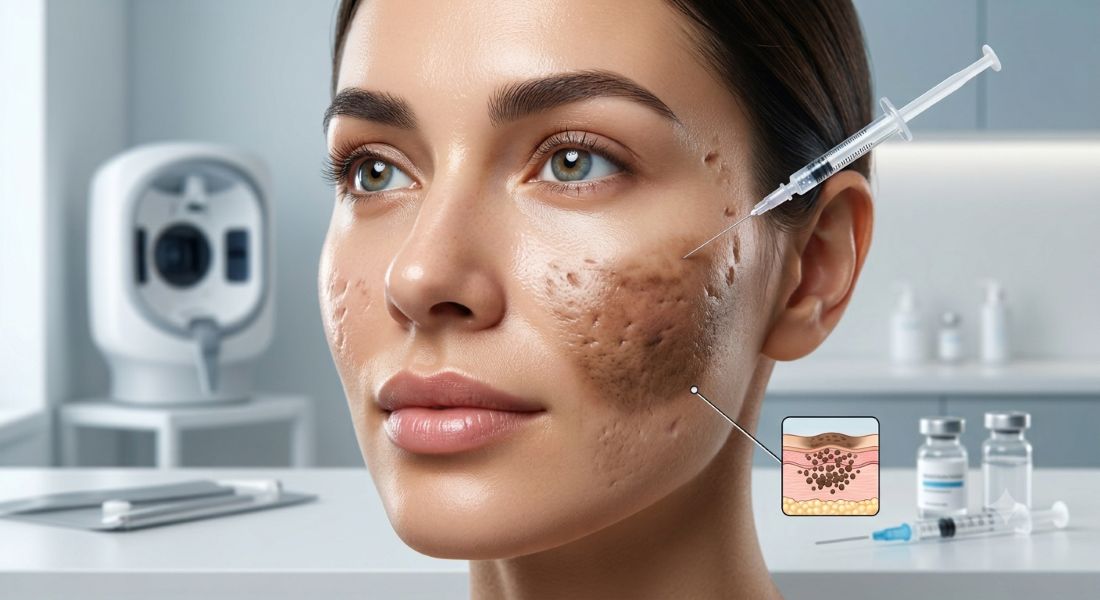
Acne scars are hard enough to live with. So when the treatment meant to improve them brings a fear of darker skin, it is natural to pause and think before taking the next step.
That worry is not without reason. Indian skin reacts to heat, friction and irritation in its own way, and the result is not the same for every person or every procedure. The outcome depends on skin type, the kind of treatment, sun exposure and how the skin is cared for afterwards.
Why Does Indian Skin Turn Darker After Some Acne Scar Treatments?
Skin has a built-in way of protecting itself. When it is hurt, burnt or irritated, it tells the pigment cells to make more colour. Think of a small cut or a mosquito bite that leaves a dark spot long after it has healed.
Many scar treatments work by causing a controlled injury to the skin, so the same response can appear after a procedure.
What is happening inside the skin
The pigment cells (melanocytes) produce extra melanin, and this collects in the skin as a brown or greyish patch. Doctors call this post-inflammatory hyperpigmentation, or PIH. It is a change in colour, not a new scar.
Why the risk is higher in Indian skin
Indian skin naturally has active pigment cells, which is why it reacts more strongly than lighter skin. A few other factors add to this:
- Strong sunlight for most of the year
- Old pimple marks that can deepen after irritation
- Heat or friction during a procedure
- Picking, scrubbing or peeling at healing skin
Which Acne Scar Treatments Are More Likely to Cause Darkening?
Not every procedure treats the skin in the same way. What matters is how much heat or injury it causes and how deep it goes.
Procedures that may carry a higher risk
These work on the surface layers and can cause more irritation, especially at strong settings:
- Ablative lasers: They remove the top layer of skin using heat.
- Deep chemical peels: High-strength acids can irritate darker skin.
- Dermabrasion: The skin surface is scraped away.
- High-intensity settings on any device: Even a milder device can cause darkening when the settings are too strong.
Procedures often considered gentler
These usually cause less heat or surface injury, though none is risk-free:
- Microneedling: Tiny needles create small channels in the skin without using heat.
- Superficial peels: Mild acids at low strength.
- Lasers designed with darker skin tones in mind: Their settings are adjusted for the skin's response.
- Subcision: Used for deep, tethered scars, and it works under the skin rather than on the surface.
The name of the treatment alone does not decide the risk. The doctor's assessment, the settings and the technique matter just as much. This is why anyone looking into acne scar treatment in Kolkata or any other city is usually advised to have skin type and scar type checked first.
How Do I Know Whether It Is a Dark Mark or a Real Scar?
Many people call every mark on the face a scar, but dark marks and true scars are different problems. They need different care, and they behave differently over time.
A simple check is to look at the area in side light and touch it gently. If the skin feels smooth and only the colour is different, it is likely a dark mark.
| Dark mark (PIH) | Acne scar |
| Flat, at the same level as the skin | A pit, dent or raised bump |
| Brown, grey or purple in colour | Skin colour may be normal, pale or red |
| Usually fades slowly with time | Does not fade on its own |
| Caused by extra pigment | Caused by loss or excess of skin tissue |
Common types of acne scars
Scars come in different shapes, and this is what guides the choice of treatment:
- Icepick scars: Narrow, deep, pinpoint holes
- Boxcar scars: Round or oval dents with sharp edges
- Rolling scars: Wide, shallow, wavy dents
- Raised scars: Thick, firm scars, more common on the chest, back and jawline
Because each type behaves differently, one treatment does not suit every scar. A doctor usually examines the skin in person before deciding what may work.
How Long Does the Darkening Last, and Can It Become Permanent?
This is often the biggest worry, and the honest answer is that it varies. Skin heals at its own pace, and the depth of the pigment matters.
- Mild, surface-level darkening may fade over a few weeks to a few months.
- Deeper darkening can take six months to a year, sometimes longer.
- Repeated irritation or sun exposure can slow the fading.
When can it stay longer?
PIH is usually temporary, but it can stay for a long time in some cases. This is more likely when the skin is exposed to sun again and again during healing, when picking or scrubbing continues, or when the darkening is left unmanaged for months.
The skin needs calm, protection and time. Rushing it with harsh products often makes the patch stubborn.
What Can I Do Before and After Treatment to Lower the Risk?
The risk cannot be brought down to zero, but preparation and aftercare make a real difference. Most of it is simple and can be done at home.
Before the procedure
The skin should be as calm and healthy as possible before any treatment begins:
- Get the skin type, scar type and pigment history assessed
- Settle active acne, redness or infection first
- Avoid tanning and heavy sun exposure for a few weeks
- Tell the doctor about creams, medicines and any past skin reactions
During the procedure
The doctor decides these, but it helps to know what to expect:
- Gentler settings and lower-strength products are often chosen for darker skin
- Sessions are usually spaced out so the skin gets time to recover
- Overlapping passes on the same area may be avoided
After the procedure
Aftercare is where much of the outcome is decided:
- Apply a broad-spectrum sunscreen with SPF 30 or higher every day
- Cover the face with a hat, scarf or umbrella outdoors
- Do not pick, scrub or peel the skin
- Use only the creams the doctor has prescribed
- Keep the skin moisturised
Sun protection deserves special attention. Even a short stretch in the sun while the skin is healing can trigger fresh pigment.
Who Should Be Extra Careful Before Starting Scar Treatment?
Some skin histories make pigmentation more likely, so it helps to know where you stand. Being open about these with the doctor allows a more careful plan.
- A habit of developing dark marks after every pimple or small cut
- Active acne, redness or infection on the skin
- A recent sunburn or fresh tan
- Use of certain acne medicines, which the doctor may ask to be paused
- A history of raised or thick scars
- Pregnancy or hormonal changes, which can make pigment cells more active
What Should I Do If My Skin Has Already Turned Darker?
First, stay calm. Darker patches after a procedure are a known possibility, and there are sensible steps to follow. It is best to avoid quick fixes from social media or home remedies, since these can irritate the skin further.
Steps that usually help
- Stop harsh scrubs, home peels and strong acids
- Apply sunscreen every day, even indoors near windows
- Keep the skin moisturised
- Have the area checked by a dermatologist
What a doctor may consider
- Prescription creams that control pigment
- Mild peels at safe strengths
- Pausing any active procedure until the skin settles
Treating darkening early is generally easier than treating it after months of sun exposure.
Making a Well-Informed Decision About Your Skin
Acne scar treatment can affect Indian skin in different ways. Darkening is a known possibility, and it depends on the procedure, its settings, sun exposure and aftercare. Understanding these factors makes it easier to ask the right questions and decide calmly.
If you are considering acne scar treatment in Kolkata or elsewhere, it is advisable to have your skin assessed by a qualified dermatologist before starting any procedure.
Author:
Dr. Oindrila Dutta
Consultant Dermatologist and Dermatosurgeon
MBBS (Gold Medalist)
MD in Dermatology
International Fellowship in Aesthetic & Laser Dermatology (DIAS, ASI-Australia)
Frequently Asked Questions
1. Can lasers for acne scars make my skin darker?
It can, in some cases. Lasers use heat, and darker skin may respond by making extra pigment. The risk depends on the type of laser, its settings and how well the skin is protected from the sun afterwards.
2. Is microneedling suitable for dark Indian skin?
Microneedling does not use heat, so it is generally considered to carry a lower risk of darkening. It is not risk-free, though. The result depends on needle depth, technique and aftercare.
3. How long do dark patches take to fade after scar treatment?
Mild patches may fade over a few weeks to a few months. Deeper ones can take six months to a year or longer. Daily sunscreen and avoiding irritation can support the fading process.
4. Should I use sunscreen after acne scar treatment?
Yes. Treated skin is more sensitive to sunlight, and sun exposure is one of the main triggers for pigmentation. A broad-spectrum sunscreen with SPF 30 or higher is generally advised every day.
5. Can dark marks and acne scars be treated together?
Sometimes, but the order matters, as they are different problems. A doctor may first calm the skin and control pigment, then plan scar treatment step by step.
Disclaimer: This blog is for general educational purposes only. It is not a substitute for professional medical advice, diagnosis, or treatment. Every person's skin is different, so please consult a qualified surgeon for advice about your own health.
Ready to Transform Your Skin Health?
Take the first step towards a radiant, healthy skin with expert care from Dr. Oindrilla Dutta. Book your consultation today and discover personalized solutions for all your dermatological needs!

Recent Post
-
-
October 17, 2026
Can Acne Scar Treatment Make Indian Skin Darker?
-
 October 07, 2026
Skin Looking Dull & Dehydrated? Know What Skin Boosters Can Do