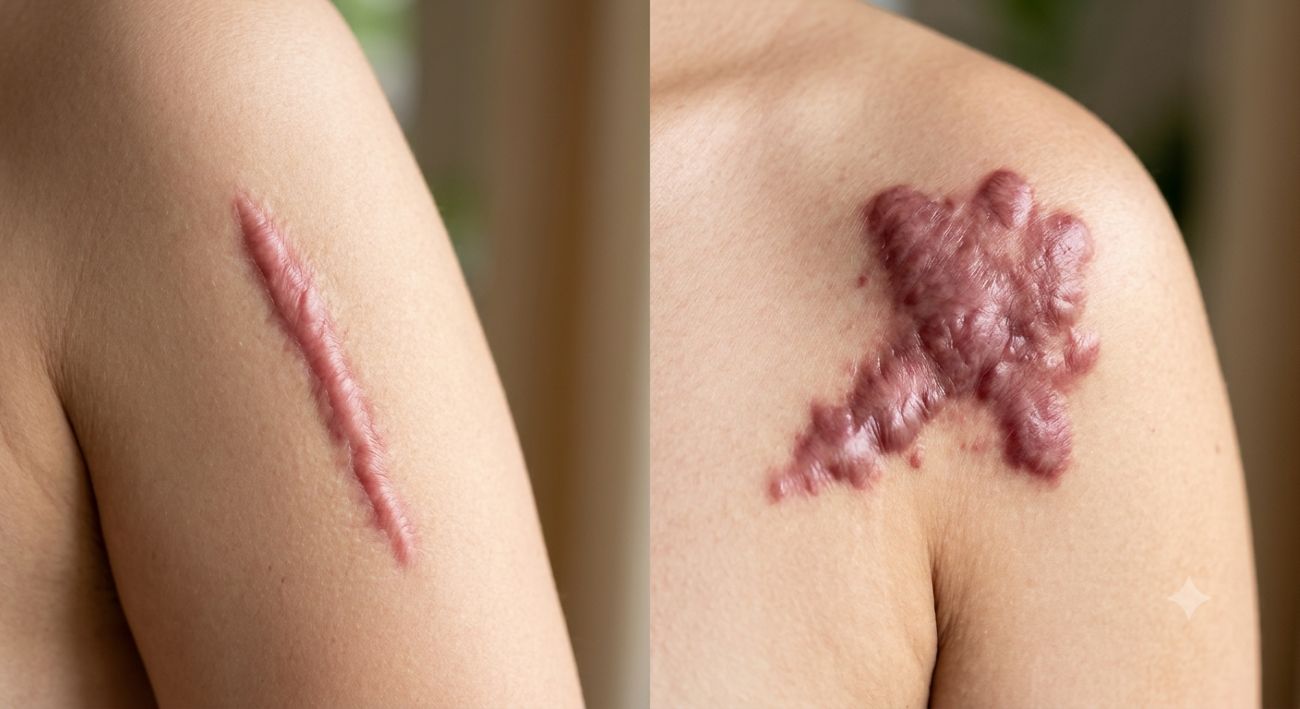
A raised scar appears and the first thought is: Is this a keloid? It is one of the most common concerns that comes up in practice. The answer is not always yes. Raised scars come in different forms, and each one behaves differently. Knowing which type you are dealing with matters because the approach to each is not the same.
Individual results and skin conditions vary. Please consult a qualified dermatologist for a personalised assessment.
A Scar Is Not Just a Scar
When skin is injured, the body repairs it by producing collagen. This is a natural, necessary process. In most cases the skin heals cleanly and the scar flattens over time.
In some cases the body produces more collagen than needed. This is when a raised scar forms.
But not all raised scars are the same. Two of the most commonly confused types are hypertrophic scars and keloids and while they may look similar at first glance, they are biologically different and behave very differently over time.
What Is a Hypertrophic Scar?
A hypertrophic scar is a raised, firm scar that stays within the boundary of the original wound.
What it typically looks like:
- Raised and red or pink shortly after healing
- Firm to touch, sometimes mildly itchy in the early weeks
- Stays confined to the area where the injury occurred
- May gradually soften and fade over months though not always completely
Where it commonly appears:
- Surgical incisions
- Burn sites
- Deep cuts or injuries
- Chest and shoulder areas, sites with higher skin tension
An important distinction: hypertrophic scars often improve with time, particularly in the first one to two years. Individual response varies depending on wound depth, location, and skin type.
What Is a Keloid And How Is It Different?
A keloid is a scar that grows beyond the original wound boundary and does not stop on its own.
What makes it clinically different:
- Extends past the injury site; sometimes significantly
- Can appear weeks or even months after the wound has healed
- Does not regress with time and tends to continue growing slowly
- More likely to itch persistently or feel tender
- Can be triggered by minor skin trauma such as ear piercing, vaccination, a small cut
Where keloids most commonly appear:
- Earlobes; one of the most frequent sites
- Chest and upper back
- Shoulders and jawline
- Vaccination or injection sites
A note on Indian skin: According to research keloid formation is more common in individuals with darker skin tones, including South Asian skin, due to differences in collagen response and melanocyte activity. This does not mean every person with darker skin will develop keloids, but the tendency is higher and worth monitoring.
Keloid vs Hypertrophic: Side by Side Comparison
| Feature | Hypertrophic Scar | Keloid |
| Stays within wound boundary | Yes | Grows beyond |
| Appears immediately after healing | Yes | Sometimes weeks or months later |
| Fades or improves with time | Often | Rarely; tends to grow |
| Common in Indian skin | Yes | Yes, more pronounced tendency |
| Itching or tenderness | Mild, early on | Often ongoing |
| Recurs after treatment | Less likely | More likely without combined approach |
| Triggered by minor injuries | Less common | Yes, even piercings or injections |
A raised scar that is growing, not settling, or appeared well after the wound healed, deserves a clinical assessment rather than a wait-and-watch approach.
What Triggers These Scars More Than You Think
Patients are often surprised by what can trigger a raised scar. Common causes include:
- Ear and body piercings: one of the most frequent keloid triggers, particularly on earlobes
- Surgical incisions: even clean, well-sutured wounds can develop hypertrophic scarring
- Severe acne: both hypertrophic and keloid scars can follow deep or inflamed breakouts
- Burns: hypertrophic scarring is particularly common post-burn
- Vaccination sites: keloids at BCG and other injection sites are well documented
- Chickenpox: raised variants can occur alongside the more common pitted scars
For people with a known tendency toward keloids, if a parent or sibling has had one, the risk is higher and even a minor scratch can be a trigger. This is worth knowing before any elective procedure or piercing.
Scar Treatment in Kolkata: What Is Available?
Treatment for raised scars is always decided after a proper assessment and not before. The type, size, location, skin tone, and individual history all influence what approach is appropriate.
Here is an overview of what is used in clinical dermatology in Kolkata for raised scars:
| Approach | What It Does | Typically Used For |
| Intralesional injections | Reduces scar thickness and collagen activity | Keloids, hypertrophic scars |
| Cryotherapy | Flattens raised scar tissue | Smaller keloids, hypertrophic scars |
| Laser therapy | Reduces redness, texture, and scar height | Both types |
| Silicone sheets or gel | Pressure and hydration-based flattening | Hypertrophic scars, early keloids |
| Surgical removal | Removes scar tissue, often combined with other treatments | Select cases |
One important clinical point is that keloids treated with surgery alone carry a higher chance of recurrence. This is why combined approaches are typically considered rather than a single intervention.
For acne scar treatment in Kolkata, where scarring has developed from previous breakouts, the assessment also considers whether the scar is atrophic, hypertrophic, or keloid in nature, as each requires a different management plan.
Results vary between individuals. No single treatment guarantees complete resolution. A personalised assessment determines the most suitable approach.
When Should You See a Dermatologist?
Some signs that a raised scar warrants professional evaluation:
- The scar is growing beyond the original wound area
- It has been more than six months and the scar is still raised and red
- The scar itches, feels tender, or causes regular discomfort
- A raised scar has appeared at a piercing or vaccination site
- The scar is on a visible area and affecting confidence
- There is a family history of keloids and an elective procedure is being planned
Earlier assessment generally means more treatment options. A dermatologist in Kolkata can identify the scar type, assess skin tone and individual history, and outline what management options are available, without any obligation to proceed.
Know What It Is Before Deciding What to Do
A raised scar that is not fading is not always a keloid and a keloid is not always what it first appears to be. The distinction matters because the management of each is different, and starting with the wrong assumption can lead to incomplete results or unnecessary concern.
The most useful first step is understanding which type of scar is actually present. A proper skin evaluation with a qualified skin specialist in Kolkata provides that clarity and from there, an informed decision can be made about whether any intervention is needed, and what that might involve.
Not every raised scar needs treatment. But every raised scar that is growing, persisting, or causing discomfort deserves to be properly assessed.
Author:
Dr. Oindrila Dutta
Consultant Dermatologist and Dermatosurgeon
MBBS (Gold Medalist) | MD in Dermatology
International Fellowship in Aesthetic & Laser Dermatology (DIAS, ASI-Australia)
Frequently Asked Questions
1. Can a keloid go away on its own without treatment?
Keloids rarely resolve without intervention. Unlike hypertrophic scars, they do not typically improve with time and tend to grow slowly. Early assessment by a dermatologist helps determine whether and when treatment is appropriate.
2. Why did I get a keloid from ear piercing and what can be done?
Ear piercing is one of the most common keloid triggers, particularly on earlobes. People with a genetic tendency toward keloids are more susceptible. Treatment options include intralesional injections, cryotherapy, or a combination approach and assessed individually.
3. Does removing a keloid make it come back?
Surgical removal alone carries a relatively high recurrence rate for keloids. Combined approaches such as surgery followed by injections or other treatments are typically considered to reduce the likelihood of recurrence. Individual outcomes vary.
4. Is the treatment for hypertrophic scars different from keloid treatment?
Yes, while some treatments overlap, the approach differs. Hypertrophic scars often respond to silicone and time. Keloids typically require more targeted interventions. Accurate identification of the scar type is the starting point for any treatment decision.
5. How much does scar treatment cost in Kolkata?
Pricing varies depending on the scar type, size, location, number of sessions required, and the treatment approach used. Indicative costs are discussed during a personalised consultation, there is no fixed pricing, as treatment plans are built around individual assessment.
Disclaimer: This content is for general educational purposes only and does not constitute medical advice. Outcomes vary between individuals. Please consult your treating doctor for a personalised assessment before starting any treatment.
Ready to Transform Your Skin Health?
Take the first step towards a radiant, healthy skin with expert care from Dr. Oindrilla Dutta. Book your consultation today and discover personalized solutions for all your dermatological needs!

Recent Post
-
 October 07, 2026
Skin Looking Dull & Dehydrated? Know What Skin Boosters Can Do
-
 September 28, 2026
Why Does My Ingrown Toenail Keep Coming Back After Surgery?
-
September 21, 2026
Not Every Raised Scar Is a Keloid: Know the Difference