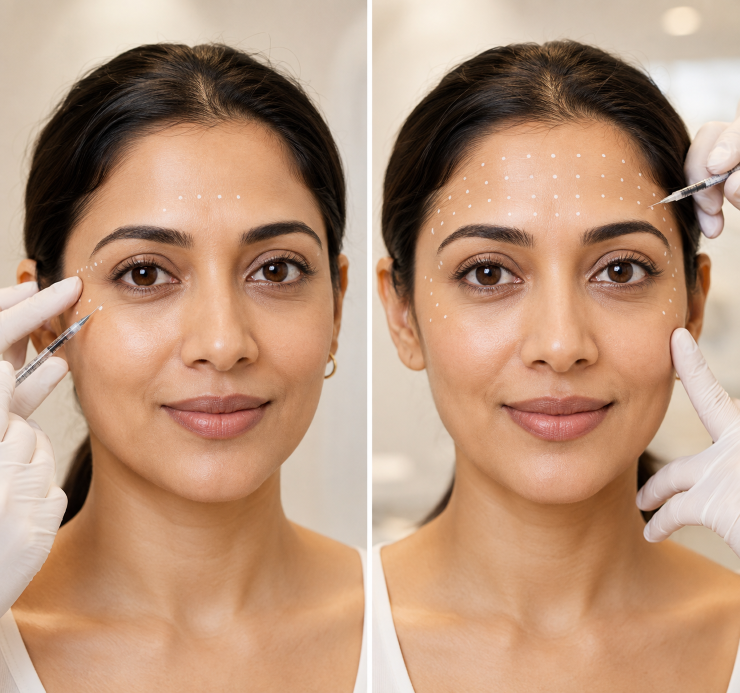
When we talk about non-surgical facial rejuvenation, we mostly think of injectables. Yet, feel skeptical about which one to go for!
“Baby Botox” may sound like a completely different treatment, but it is not a separate toxin. It usually refers to using smaller, carefully placed doses of botulinum toxin to soften selected facial movements while preserving natural expression.
So, in the debate between Baby Botox and regular Botox, the difference lies in the dose, application technique, treatment strategy, and results—not a different ingredient.
What Is Baby Botox?
Baby Botox is an informal aesthetic term rather than a separate medical product. It is a more diluted dose of botulinum toxin injections.
Traditional Botox temporarily reduces the activity of selected facial muscles that contribute to dynamic expression lines. With Baby Botox, the aim is to soften mild fine lines while retaining a natural, glowing look. It is usually spread in micro-aliquots throughout the treatment area.
However, the treatment varies based on factors such as the area, facial anatomy, muscle strength, and the product being used.
How Is Baby Botox Different From Regular Botox?
1. Dosage and Application Technique
Unlike Botox, where around 20 - 40 units are typically used, in Baby Botox nearly half that dose is administered to smooth out texture and provide radiance.
2. Areas Treated
Baby Botox may be considered in many of the same facial regions where cosmetic botulinum toxin is commonly used, including:
- Forehead lines
- Frown lines
- Lateral canthal lines, commonly called crow’s feet
The exact sites and dose should still be individualised because brow position, muscle strength, expression patterns and facial asymmetry differ from person to person.
3. Longevity
One common question is whether Baby Botox lasts as long as regular Botox.
There is no fixed duration because Baby Botox does not have a standardised dose. A lower-dose treatment may wear off sooner than a standard-dose treatment in some people.
In general, baby botox may last around 2-3 months.
When Should You Consider Baby Botox?
You may consider this skin rejuvenation treatment if:
- You’re a First-time Botox user.
- Have mild wrinkles and fine lines.
- Want to retain a soft, natural look
- Has relatively lower muscle strength in the treatment area
However, age alone should not determine the dose.
A younger person may have strong facial muscles, while another person may require much less toxin in the same area.
Lines that remain visible even when the face is completely relaxed may also involve structural changes within the skin. Botulinum toxin reduces muscle activity; it does not address every component involved in skin ageing.
A facial assessment is therefore more useful than choosing a technique simply because it carries the word “Baby.”
What Are the Possible Side Effects?
Both Botox treatments can cause side effects. Using a smaller dose does not make the procedure risk-free.
Possible temporary effects include:
- Tenderness or discomfort
- Redness or swelling
- Bruising
- Headache
- Slight weakness in nearby muscles
- Changes in eyelid or eyebrow position in some cases
Botulinum toxin also carries specific warnings and contraindications, which is why any treatment decision requires proper medical assessment
Quick Comparison: Baby Botox vs. Traditional Botox
| Feature | Baby Botox | Regular Botox |
| Approach | Lower-dose, conservative strategy | Standard or clinically selected dosing |
| Purpose | Softens fine lines while keeping expressions natural. | Mostly to relax muscles to cut down on wrinkles. |
| Injection depth | Often intramuscular depending on the target | Commonly intramuscular for approved facial indications |
| Facial movement | Usually aims to retain more movement | Depends on dose, placement, and muscle strength |
| Common areas | Forehead, frown lines, crow’s feet | Not concentrated to facial areas. |
| Longevity | May be shorter with lower dosing | About 3–4 months for labelled onabotulinumtoxinA treatment of glabellar lines |
Treatment technique, dose and duration vary between individuals and botulinum toxin formulations.
Aftercare: Botulinum Toxin Injections
Aftercare can vary depending on the area treated and injection technique. Instructions given by the treating doctor should take priority.
- Avoid pressing, rubbing or massaging the treated areas unless advised otherwise.
- Be gentle with skincare around the injection points on the day of treatment.
- Avoid facial massage or vigorous manipulation of the treated area until advised that it is appropriate.
- Do not judge the effect immediately. Botulinum toxin activity develops gradually after injection.
- Contact the treating doctor if unexpected drooping, persistent visual symptoms or another concerning local reaction develops.
- Seek urgent medical care for difficulty swallowing, speaking or breathing, or for generalised muscle weakness.
In a Nutshell
Baby Botox and regular Botox are not two different medicines. The key difference is – how much toxin is used, where it is placed, and how much muscle activity the treatment is intended to reduce.
Baby Botox is best understood as a more conservative dosing strategy.
What you need to understand is that, in Baby Botox, smaller and more strategically placed doses are used to achieve a softer, more natural reduction in muscle activity. Whereas regular Botox uses standard or clinically appropriate dosing to achieve a more defined and sometimes stronger relaxation of targeted muscles.
As individual results may vary, always consult for personalised assessment.
Author:
Dr. Oindrila Dutta
Consultant Dermatologist and Dermatosurgeon
MBBS (Gold Medalist)
MD in Dermatology
International Fellowship in Aesthetic & Laser Dermatology (DIAS, ASI-Australia)
Frequently Asked Questions
1. Is Baby Botox better than regular Botox?
Not necessarily. Baby Botox uses a more conservative dose and may be considered when retaining more facial movement is desired. Regular dosing may be more appropriate when stronger muscle activity requires greater modulation. The choice should depend on clinical assessment rather than assuming one approach is superior.
2. Is Baby Botox the same thing as Microbotox?
No. Baby Botox is about using a smaller amount with the standard technique, while Microbotox is a different, more superficial injection method altogether.
3. How long does Baby Botox last?
There is no fixed duration because there is no standardised Baby Botox dose. Lower-dose treatment may wear off sooner in some people. By comparison, labelled onabotulinumtoxinA treatment for glabellar lines has an approximate duration of three to four months.
4. Will Baby Botox completely freeze facial expressions?
That is generally not the intention of a conservative dosing approach. Smaller doses may be selected when the aim is to reduce specific muscle activity while retaining more movement. The actual effect depends on dose, injection placement, anatomy, and muscle strength, and results vary.
5. Can someone choose Baby Botox simply because they are younger?
Age alone should not determine botulinum toxin dosing. Facial anatomy, muscle strength, expression pattern, medical history, and individual treatment goals all need to be considered before deciding on an appropriate approach.
This content is for general educational purposes and does not constitute medical advice. Individual results vary. Please consult a qualified medical practitioner for a personalised assessment.
Ready to Transform Your Skin Health?
Take the first step towards a radiant, healthy skin with expert care from Dr. Oindrilla Dutta. Book your consultation today and discover personalized solutions for all your dermatological needs!

Recent Post
-
 October 07, 2026
Skin Looking Dull & Dehydrated? Know What Skin Boosters Can Do
-
 September 28, 2026
Why Does My Ingrown Toenail Keep Coming Back After Surgery?
-
 September 21, 2026
Not Every Raised Scar Is a Keloid: Know the Difference