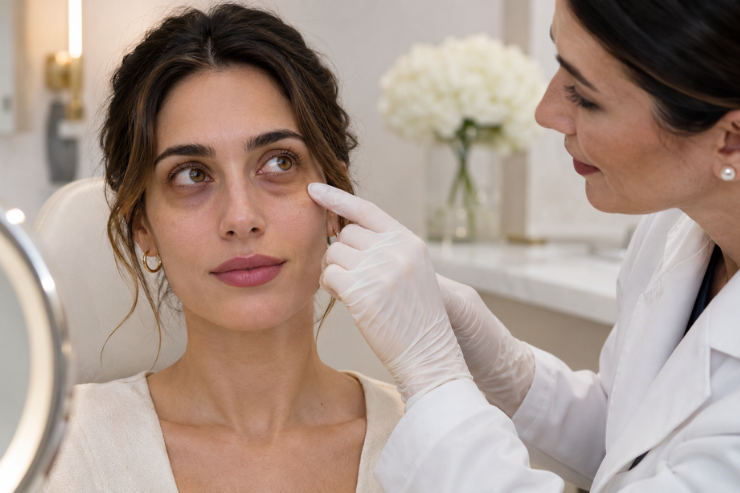
You get a full night’s sleep, yet the mirror still shows dark circles. Then someone asks, “Are you feeling okay? You look tired,” and you smile politely, even though you feel fine.
As a dermatologist, I hear this concern almost every day. Dark circles have different causes, and under-eye fillers suit only some of them. This guide explains when fillers help, when they don’t, and what else you can do.
Why Do Dark Circles and Sunken Eyes Appear?
Many people blame lack of sleep, but it is rarely the only reason. From a skin point of view, the under-eye area is the thinnest on the body, so it shows every change.
Common Causes
- Pigmentation: Extra melanin makes the skin look brown or grey. This is the most common type in Indian skin.
- Genetics: Dark circles often run in families and can start in childhood.
- Thin skin: Blood vessels show through as a bluish or purplish tint.
- Hollowing (tear trough): A groove between the eyelid and cheek casts a shadow that looks like a dark circle.
- Ageing: Fat and collagen reduce, and the cheek loses support.
- Allergies and eye rubbing: Constant itching and rubbing darken the skin.
- Sun and lifestyle: Sun exposure, poor sleep, stress and screen strain make existing circles look worse.
How Do You Know Which Type You Have?
A quick check at home gives a clue. It does not replace an examination.
Three Simple Checks
- Stretch the skin gently sideways. If the darkness stays, it is likely pigmentation.
- Tilt your face up under overhead light. If the dark area fades, it is likely a shadow from hollowing.
- Look for a bluish tint. This suggests thin skin with visible vessels.
Most people have a mix of causes, which is why a skin assessment matters.
What Are Under-Eye Dermal Fillers?
Under-eye fillers are soft gels, usually hyaluronic acid (HA), a substance your body already makes. It is placed in the tear trough area to add volume.
This softens the groove and reduces the shadow. That is why dark circles dermal fillers work for shadow-type circles, not for colour-based ones.
When Under-Eye Fillers May Help
Fillers are considered when you have:
- A visible hollow or groove under the eyes
- Dark circles that look worse in overhead light
- Sunken eyes from ageing or weight loss
- Good skin thickness and elasticity
- Little or no puffiness
What Results Look Like
Results are subtle. The goal is a rested look, not a different face. HA fillers are temporary and usually last 6 to 12 months.
When Under-Eye Fillers Do NOT Help
Fillers can disappoint, or even worsen the look, in these cases:
- Pigmentation: Filler adds volume, not colour correction.
- Puffy eye bags: Extra volume can make bags look heavier.
- Loose, crepey skin: Filler cannot tighten skin.
- Very thin skin with visible vessels: The bluish tone may remain.
- Allergy-related darkness: The allergy needs treating first.
- Active infection or skin disease around the eyes: Treatment should wait.
- Pregnancy or breastfeeding: Elective fillers are usually postponed.
Skin-Based Treatments for Dark Circles
For many people, especially with pigmentation, skin treatment is the better starting point.
For Pigmentation
- Daily sunscreen: The single most important step
- Topical ingredients: Vitamin C, retinoids, niacinamide, kojic acid or azelaic acid, as advised by a doctor
- Chemical peels: Mild, eye-safe peels in suitable cases
- Laser treatments: Selected lasers for stubborn pigment
For Thin Skin and Early Ageing
- Regular, gentle moisturising
- PRP or microneedling to support collagen, when advised
For Puffiness or Bags
- Allergy control and less salt in the diet
- Eyelid surgery for true fat bags or excess skin
For Deep Hollows
- Fillers or fat transfer, depending on the person
Everyday Habits That Help
- Sleep 7 to 8 hours regularly
- Drink enough water
- Avoid rubbing your eyes
- Take screen breaks
- Manage allergies
What to Expect During Treatment
Before
A doctor examines your skin, face and medical history. You should be told clearly if fillers are suitable.
During
- Numbing cream may be applied
- Tiny amounts are injected slowly
- The session takes about 30 to 45 minutes
After
- Mild swelling, redness or bruising for a few days
- Avoid heavy exercise, heat and rubbing for a day or two
- Final results settle in about two weeks
Ready to Transform Your Skin Health?
Take the first step towards a radiant, healthy skin with expert care from Dr. Oindrilla Dutta. Book your consultation today and discover personalized solutions for all your dermatological needs!

Recent Post
-
 November 20, 2026
Can a Mole Be Removed Without Leaving a Scar?
-
 November 15, 2026
Lump Under the Skin: Cyst, Lipoma, or Something Else?
-
 November 10, 2026
Itchy, Cracked Skin Every Winter? Here's How to Know If It's Eczema