Most people notice a mole on their face long before anyone else does. It may sit near the nose, on the cheek or along the jawline, and every glance in the mirror seems to pull the eye towards it. Wanting it gone is natural. So is the worry that comes next: will the removal leave a mark that looks worse than the mole itself?
The honest answer is that face mole removal without scarring, in the sense of a very faint and barely noticeable mark, is possible in many cases. A completely invisible result cannot be promised to everyone, because every person's skin heals in its own way. What decides the outcome is worth understanding before any decision is made.
Understanding Moles Before Removal
A mole is a small cluster of pigment-producing cells in the skin. Its depth, colour and shape decide which removal method suits it, and that in turn affects how the skin heals.
Common types of moles
- Flat moles: Sit level with the skin and are usually brown or tan. Often the easiest to treat.
- Raised moles: Stand above the skin surface and may be skin-coloured or dark.
- Deep moles: Extend into the lower layers of skin, so removal needs more care.
- Moles present since birth: Can be larger and need a proper medical assessment first.
Can a Mole Really Be Removed Without a Scar?
In most cases, removal leaves some change in the skin, because any procedure that removes tissue triggers healing. The aim of a good plan is to keep that change as small, flat and pale as possible.
What "minimal scarring" actually means
A well-healed site often becomes a fine line or a faint, flat patch that blends with the surrounding skin. Many people find it hard to spot after a few months.
Why a zero-mark result cannot be guaranteed
The size and depth of the mole, the area of the face, skin type and aftercare all influence healing. Anyone who promises a guaranteed scar-free result is overstating what medicine can control.
Medical Methods Used to Remove Moles
There is no single best technique. The right choice depends on the mole's type, its location and whether the removed tissue needs to be tested.
Shave removal
The raised part of the mole is trimmed level with the skin after numbing. It suits raised, clearly benign moles and often heals with a flat, light mark.
Surgical excision
The entire mole is cut out and the skin is closed with fine stitches. It is preferred for deeper moles or any mole that looks unusual, since the full tissue can be sent for testing.
Laser removal
Laser energy breaks down the pigment in flat, superficial moles. It is not suitable for every mole, particularly those that need tissue testing.
Radiofrequency removal
A fine electrical tip removes the mole layer by layer with good control, which can help in delicate areas of the face.
Cryotherapy
Freezing is sometimes used for small surface growths, but it is generally not the first choice for facial moles. It gives no tissue for testing and can lighten the surrounding skin.
Factors That Decide How a Mole Scar Looks
Two people can have the same mole removed and heal very differently. These factors explain why.
- Depth of the mole: Deeper moles need deeper removal, which leaves a more noticeable mark.
- Location on the face: Areas under tension, such as the area near the mouth or the jawline, may heal differently from the forehead or cheek.
- Skin type: Indian skin is more prone to dark marks after healing, known as post-inflammatory pigmentation. Some people also tend to form raised, thick scars.
- Sun exposure: Unprotected sun on healing skin can darken the mark.
- Aftercare: Picking, rubbing or poor wound care can turn a neat wound into a visible scar.
- Infection: Even a mild infection can worsen scarring.
What to Expect During a Mole Removal Procedure
The process is usually short and done in a day-care setup, without a hospital stay. Knowing the steps removes much of the anxiety.
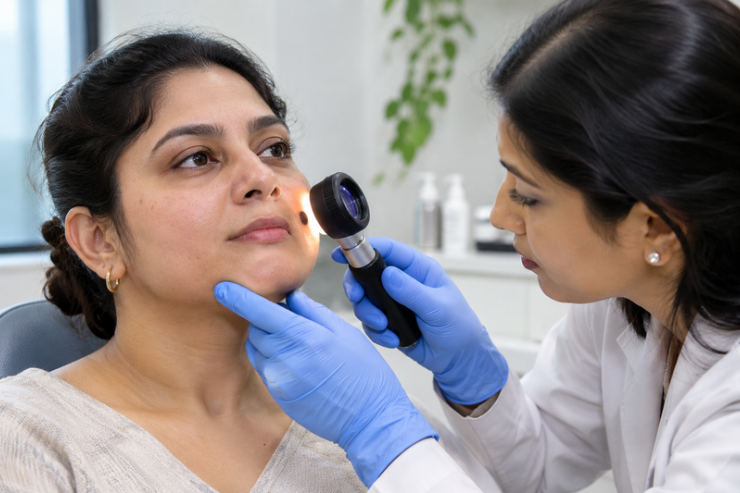
- Skin examination: The mole is checked closely, often with a magnifying device, to understand its type and depth.
- Numbing: A local anaesthetic is applied or injected, so the area feels little more than pressure.
- Removal: The chosen technique is carried out, usually within minutes.
- Closure and dressing: Stitches or a simple dressing protect the area.
- Tissue testing: When appropriate, the removed mole is sent to a laboratory to confirm it is harmless.
Aftercare That Helps the Skin Heal Cleanly
What happens after the procedure matters as much as the procedure itself. Careful aftercare is the most controllable part of achieving face mole removal without scarring.
Daily care steps
- Keep the area clean and covered as advised.
- Apply the prescribed ointment, and do not pick at scabs or crusts.
- Use a broad-spectrum sunscreen of SPF 30 or higher once the skin has closed.
- Avoid heavy sweating, swimming and facial scrubs until healing is complete.
- Keep a hat or umbrella handy, as Kolkata's strong sun and humid weather can irritate healing skin.
Typical healing timeline
A pink or reddish mark is normal in the first few weeks. Colour usually fades over two to six months, and fine scars may keep improving for up to a year.
Why Removing a Mole at Home Is Not Safe
Online videos often promote quick fixes, but the face is the worst place to experiment. Mistakes here are visible and sometimes permanent.
- Home remedies: Apple cider vinegar, garlic, baking soda and similar pastes burn the skin and can cause deep, uneven scars.
- Over-the-counter creams and pens: These can damage skin unpredictably and leave marks.
- Cutting or scraping: Risks infection, heavy bleeding and incomplete removal, and the mole may return.
- Missed warning signs: A harmful mole can be hidden by self-treatment and detected late.
Signs a Mole Needs Medical Attention
Most moles are harmless, but some changes deserve a proper check before any removal. Doctors often use the ABCDE guide to spot them.
- Asymmetry: One half looks different from the other.
- Border: Edges are uneven, blurred or notched.
- Colour: Several shades such as brown, black, red or blue appear within one mole.
- Diameter: The mole is larger than about 6 mm, roughly the size of a pencil eraser.
- Evolving: It changes in size, shape or colour, or begins to itch, bleed or crust.
A mole showing any of these changes should be examined by a qualified doctor rather than treated as a cosmetic matter.
Final Thoughts
A mole on the face can be removed safely, and with the right technique, careful planning and patient aftercare, the mark it leaves can be very faint. The best results come from understanding the mole first, choosing the method that suits it, and protecting the healing skin from the sun and from picking.
If a mole has been on your mind, a consultation with a qualified plastic surgeon or dermatologist can help you understand your options and decide what is right for your skin, at your own pace.
Frequently Asked Questions
1. Does mole removal always leave a mark?
Most removals leave some change, but it is often a faint, flat mark that blends with the skin over time. The final look depends on the mole's depth, your skin type and how well the area is cared for.
2. How long does a face mole take to heal after removal?
The surface usually closes within one to two weeks. The pink or dark colour can take a few months to fade, and the mark may keep improving for up to a year.
3. Can a mole grow back after removal?
Sometimes, yes. If a few pigment cells remain in the deeper skin, the mole can return, especially after shave removal or laser treatment. Any regrowth should be checked by a doctor.
4. Is mole removal painful?
The area is numbed first, so most people feel only slight pressure or a brief pinch. Mild soreness or tightness for a day or two afterwards is common and usually settles easily.
5. Can natural remedies remove a mole safely?
No. Natural remedies such as apple cider vinegar or garlic are not proven to remove moles, and they can burn the skin and cause scars. Moles are best removed by a trained doctor.
This article is meant for general education only and is not a substitute for professional medical advice, diagnosis or treatment. Results vary from person to person. Please consult a qualified doctor for advice about your own skin.
Ready to Transform Your Skin Health?
Take the first step towards a radiant, healthy skin with expert care from Dr. Oindrilla Dutta. Book your consultation today and discover personalized solutions for all your dermatological needs!

Recent Post
-
November 20, 2026
Can a Mole Be Removed Without Leaving a Scar?
-
 November 15, 2026
Lump Under the Skin: Cyst, Lipoma, or Something Else?
-
 November 10, 2026
Itchy, Cracked Skin Every Winter? Here's How to Know If It's Eczema