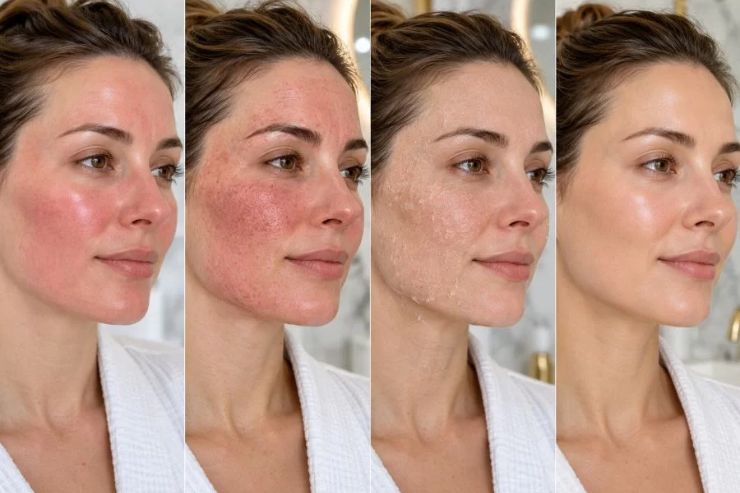
Wondering how your face will look tomorrow, or next week, after a laser treatment? This is one of the most common concerns I hear as a dermatologist. Knowing what to expect makes the process less stressful and helps you care for your skin better.
After CO2 laser resurfacing, most people have redness and swelling for the first few days, peeling around day 5 to 7, and fresh pink skin by the second week. The pinkness fades over several weeks, and skin keeps improving for 3 to 6 months.
What Is CO2 Laser Resurfacing?
CO2 laser resurfacing uses focused light energy to remove thin layers of damaged skin. As the skin heals, the body makes new skin cells and fresh collagen, the protein that keeps skin firm and smooth.
It is commonly used to improve:
- Acne scars
- Fine lines and wrinkles
- Sun damage and uneven skin texture
- Open pores
Two Common Types
Fractional CO2 laser treats tiny columns of skin and leaves the skin in between untouched. Healing is faster, with visible recovery of about 5 to 7 days.
Fully ablative CO2 laser treats the entire skin surface and goes deeper. Healing can take 10 to 14 days or longer.
Your dermatologist chooses the type after checking your skin, your concern and your health history.
Day-by-Day Recovery Timeline
Recovery varies with the laser type, the settings used and your skin. The pattern below is what most people experience.
Day 0: Treatment Day
Your skin will look red and feel warm, much like a strong sunburn. A tight, stinging feeling is normal.
- Mild swelling may begin
- A soothing ointment is usually applied
- Cool compresses may be advised
Day 1 to 2: Swelling Peaks
Swelling is usually at its highest now, especially around the eyes and cheeks. Some people also notice clear or yellowish fluid on the skin, which is part of normal healing.
Sleeping with your head slightly raised can reduce puffiness.
Day 3 to 4: Skin Begins to Dry
The oozing settles and the skin starts to dry. After a fractional treatment, it may look bronzed and feel rough, like fine sandpaper. Swelling goes down slowly during these days.
Day 5 to 7: Peeling and Itching
This is when the treated skin starts to flake and shed. Itching is common and is usually a sign that healing is on track.
Please do not pick, scratch or pull at the flakes. This can lead to marks, scarring or infection.
Day 8 to 10: New Skin Appears
Most of the peeling is over, and the skin looks pink, smooth and slightly shiny. If your dermatologist allows it, you may be able to use mineral makeup at this stage.
Week 2 to 4: Redness Settles
The pinkness fades gradually, though it can last longer in some people. Skin may feel dry, sensitive and slightly tight, so gentle care remains important.
Month 2 to 6: Collagen Builds
Healing is no longer visible on the surface, but collagen keeps building underneath. Texture, scars and fine lines continue to improve slowly. Final results are usually judged after 3 to 6 months.
Aftercare That Supports Healing
Good aftercare matters as much as the procedure itself. Your skin is like an open wound in the first week, so simple, gentle habits protect it.
- Wash with a mild cleanser and pat dry
- Use only the ointments and moisturisers your dermatologist advises
- Apply a broad-spectrum sunscreen of SPF 30 or higher every morning once allowed
- Avoid direct sun and cover your face with a hat or umbrella
- Skip heavy exercise, saunas, steam rooms and swimming for the first week
- Avoid scrubs, retinoids and acids until you are cleared
Drinking enough water and eating a balanced diet also support skin repair.
What Can Slow Down Healing?
Certain habits can delay recovery or raise the chance of problems. These include sun exposure during healing, picking at scabs, smoking (which reduces blood supply to the skin), and using strong skincare products too early.
Possible Side Effects
Most side effects are temporary, but it helps to know them in advance:
- Redness that lasts for several weeks or months
- Dark patches, called post-inflammatory hyperpigmentation, which are more common in medium to brown skin tones
- Infection, including cold sore flare-ups in people prone to them
- Rarely, scarring or lightening of the skin
Sharing your skin type, scarring tendency and current medicines with your dermatologist helps lower these risks.
When to Seek Medical Advice
Mild discomfort is expected, but contact your dermatologist promptly if you notice:
- Pain that increases instead of settling
- Pus, a bad smell or yellow crusts
- Fever
- Clusters of blisters
- Redness that keeps spreading
Who May Need to Wait?
CO2 laser resurfacing may not be suitable if you have an active skin infection, a tendency to form keloid (raised, thick) scars, or have recently taken certain acne medicines. A consultation before treatment is how these factors are checked safely.
Final Thoughts
Recovery after CO2 laser resurfacing is a step-by-step process. Redness, swelling and peeling are expected, and they gradually give way to fresher, smoother skin. Patience and careful aftercare make a real difference to how well you heal.
If you are considering CO2 laser resurfacing, a consultation with a qualified dermatologist can help you understand whether it suits your skin and what your recovery may look like.
Author:
Dr. Oindrila Dutta
Consultant Dermatologist and Dermatosurgeon
MBBS (Gold Medalist)
MD in Dermatology
International Fellowship in Aesthetic & Laser Dermatology (DIAS, ASI-Australia)
Frequently Asked Questions
1. How many days does it take to recover from a CO2 laser?
Most people heal visibly in 5 to 7 days after a fractional treatment and 10 to 14 days after a deeper, fully ablative one. Redness may take a few more weeks to fade completely.
2. Is peeling normal after laser treatment?
Yes. Peeling shows that the treated skin is shedding and new skin is forming. It usually starts around day 5 and lasts a few days. Let the flakes fall off on their own.
3. When can I wear makeup or go back to work?
Many people return to work in 5 to 10 days, depending on how their skin looks and feels. Makeup is usually restarted once the skin has closed and stopped oozing, but only after your dermatologist says it is fine.
4. Why does my skin look darker after the laser?
Skin sometimes makes extra pigment while healing, which can look like dark patches. This is more common in brown skin and with sun exposure. Strict sun protection and doctor-advised care usually help it fade.
5. When will I see the final results?
You may notice smoother skin after two to three weeks, but collagen keeps building for months. The full result is usually visible at 3 to 6 months.
This blog is for general educational purposes only and is not a substitute for professional medical advice, diagnosis or treatment. Results and recovery vary from person to person. Please consult a qualified dermatologist for advice about your own skin and health.
Ready to Transform Your Skin Health?
Take the first step towards a radiant, healthy skin with expert care from Dr. Oindrilla Dutta. Book your consultation today and discover personalized solutions for all your dermatological needs!

Recent Post
-
 November 20, 2026
Can a Mole Be Removed Without Leaving a Scar?
-
 November 15, 2026
Lump Under the Skin: Cyst, Lipoma, or Something Else?
-
 November 10, 2026
Itchy, Cracked Skin Every Winter? Here's How to Know If It's Eczema